



The retail environment of 2026 is no longer just about moving products; it is about orchestrating a frictionless journey where digital intent meets physical fulfillment. As shoppers move fluidly between social feeds, web stores, and physical aisles, the role of the retail POS system has shifted from a simple transaction counter to the operational nervous system of the entire enterprise.
However, many retailers remain anchored by a legacy POS designed for a static, single-channel era, creating a widening gap between what customers expect and what the store can actually deliver. When your technology cannot synchronize inventory, financial data, or customer profiles in real-time, you aren’t just losing efficiency; you are losing market share to agile competitors who treat data as their most valuable asset. Recognizing the subtle warning signs of a failing system is the first step toward reclaiming your competitive edge.
The High Cost of Operational Stagnation
In 2026, the global retail landscape has reached a tipping point where the divide between cloud-native platforms and “on-premise” liabilities is absolute. A legacy POS often relies on disconnected modules and manual reconciliation, which are time-consuming and prone to errors. This creates massive operational bottlenecks: stock levels are not synchronized across locations, leading to overselling or unnecessary stockout. By contrast, modern systems achieve higher levels of excellence by automating everything from inventory replenishment to multi-location financial reporting through smart technology that anticipates problems before they occur.
The Core Analysis: 7 Signs Your Technology Is a Liability
Identifying whether your system is an asset or a burden requires looking at the friction points in your daily operations. A system that holds you back often manifests as “data silos” where different departments are looking at conflicting information. If your staff spends more time troubleshooting software than serving customers, or if your marketing team can’t see what’s actually on the shelves, your infrastructure is likely stalling your growth. The following seven signs represent the critical thresholds where a retail POS system transitions from an administrative tool into a growth-limiting liability.
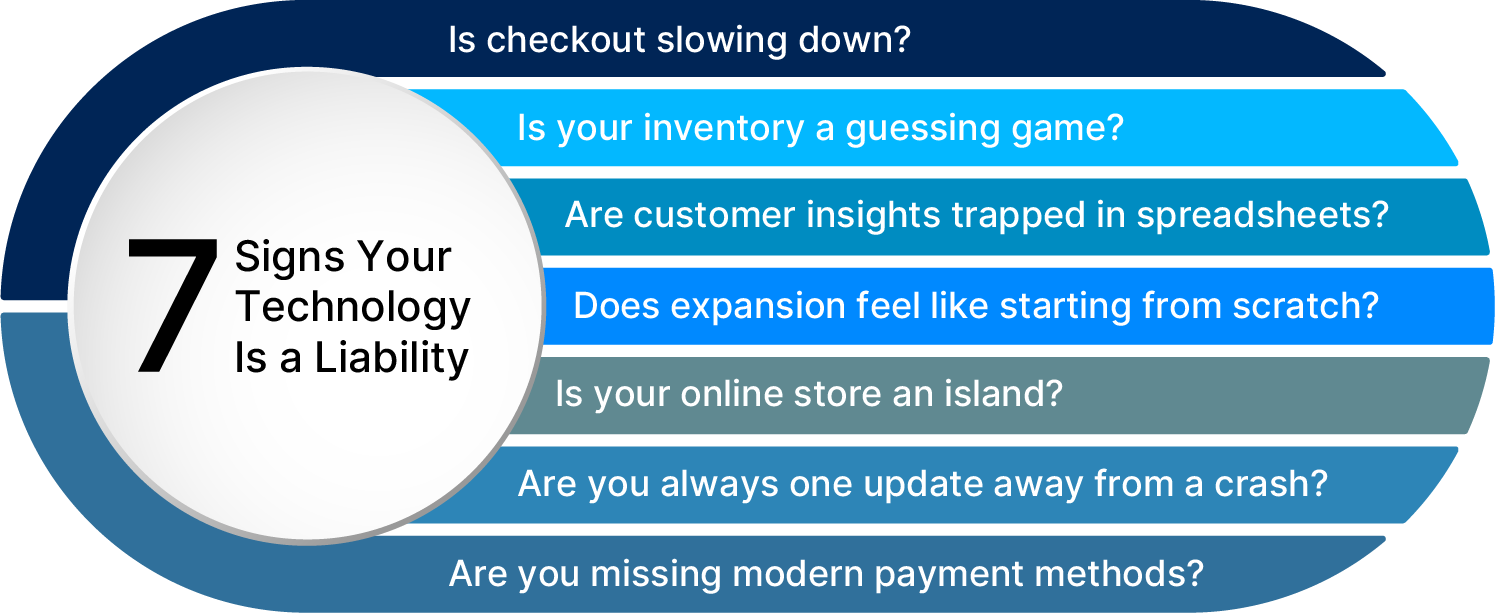
Identifying whether your system is an asset or a burden requires looking at the friction points in your daily operations. A system that holds you back often manifests as “data silos” where different departments are looking at conflicting information. If your staff spends more time troubleshooting software than serving customers, or if your marketing team can’t see what’s actually on the shelves, your infrastructure is likely stalling your growth. The following seven signs represent the critical thresholds where a retail POS system transitions from an administrative tool into a growth-limiting liability.
1. Is checkout slowing down?
Think about your last peak shopping hour. If your terminals frequently freeze or struggle to process multiple transactions while lines wrap around the aisles, your system is failing the stress test. In 2026, transaction speed is a direct threat to revenue; legacy hardware often lacks the processing power for modern “tap-to-pay” speeds, and fixed terminals prevent your staff from providing personalized service on the sales floor. Modern retail POS systems leverage customizable interfaces and real-time dashboards to keep lines moving and boost customer satisfaction.
2. Is your inventory a guessing game?
Imagine a customer walks in asking for a specific item your screen says is “in stock,” only for your associate to search the backroom and come up empty-handed. This disconnect happens because legacy systems often rely on batch processing rather than real-time, SKU-level synchronization across all warehouses and retail locations. Without unified visibility, you risk frustrating customers and missing “save-the-sale” opportunities that modern retailers capture effortlessly through intelligent stock management and automated replenishment.
3. Are customer insights trapped in spreadsheets?
If identifying your most loyal shoppers requires a manager to manually export data into Excel at the end of every week, your data is decaying before you can use it. In an era where consumers expect personalized service, static reports are no longer sufficient to drive repeat business. Modern platforms provide built-in analytics that display customer buying patterns instantly, allowing you to trigger personalized offers or loyalty rewards while the shopper is still in your store.
4. Does expansion feel like starting from scratch?
Consider the friction involved in opening a new storefront or a weekend pop-up shop. If it requires complex server installations and manual data updates, your system is built for a single-store world. Monolithic legacy systems make scaling an expensive and laborious endeavor. A scalable, cloud-native POS lets you manage multiple locations under a single dashboard, pushing pricing or product changes to hundreds of registers globally in minutes through smart technology that powers your operations.
5. Is your online store an island?
Picture a customer who buys a jacket on your website but is told they can’t return it at your physical store because your systems “don’t talk to each other.” This fragmentation is the hallmark of a legacy POS and is a primary barrier to modern retail success. Unified commerce orchestration ensures that online and offline channels are integrated, sharing data in real-time so that inventory, pricing, and customer profiles remain consistent regardless of the touchpoint.
6. Are you always one update away from a crash?
If the mere mention of a software patch makes your IT team nervous about the entire configuration “shattering,” you are living on borrowed time. Legacy systems are often a patchwork of custom code that is difficult to maintain and vulnerable to data errors. Modern platforms handle security and performance updates automatically in the background, utilizing advanced security frameworks and granular permission controls to ensure your business data is always protected.
7. Are you missing modern payment methods?
As digital wallets and QR-based payments become the global standard, a system that only accepts cash or physical cards feels ancient to the modern shopper. If your POS limits how your customers can pay, you aren’t just being traditional – you are driving convenience-focused customers toward tech-savvy competitors who make spending easy. Multi-tender payment processing and split-payment handling are now standard requirements for a frictionless checkout experience.
Strategic Path Forward: Moving Toward Unified Commerce
The enterprise playbook for 2026 is clear: automated workflows and data-centric decision-making are no longer optional. Sticking with a legacy POS isn’t a cost-saving measure; it’s a silent drain on your budget that compounds technical debt and stalls innovation exactly when you need it most. Moving toward a unified commerce model allows you to eliminate channel boundaries, creating a synchronized environment where inventory, staff, and customer intelligence work together to drive smarter decisions and faster growth.
Mastering Modern Complexity with iVend Retail
Recent Posts

7 Signs Your Retail POS System Is Holding You Back
The retail environment of 2026 is no longer just about moving products; it is about orchestrating a frictionless journey where [...]
Retail POS Systems: Making Omnichannel Retail Work
Shopping has changed. People don’t just buy in-store or online anymore - they want both. A customer might browse your [...]

POS Technology: The Heartbeat of Modern Retail
Walk into any store today and you’ll see more than shelves and smiling staff. Behind the scenes, technology is quietly [...]


